Posts

Showing posts with the label The Moral Imagination

Working with Words

“To think creatively, to struggle with an opaque text or confounding idea, to seek connections between periods of history or disciplines of thought, and to search for the precise word or the right rhythm for a single sentence—these are human actions every bit as worthy as the wielding of a hammer, the manipulation of a surgical scalpel, or the making of a courtroom argument.”  ―  Roger Lundin ,  Beginning with the Word (Cultural Exegesis): Modern Literature and the Question of Belief
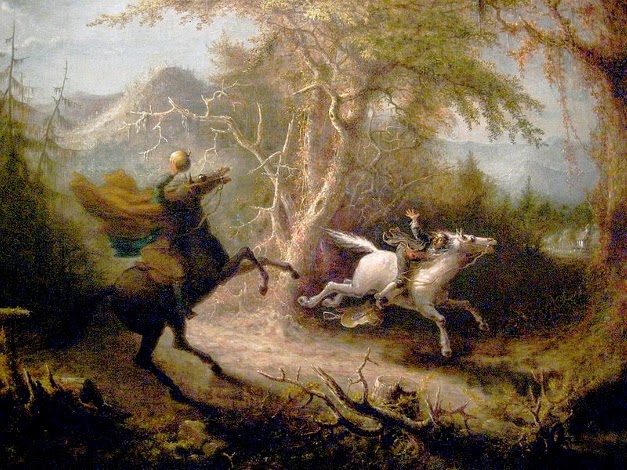
Place, Mood, and Character in Washington Irving's Ghostly Tale, "The Legend of Sleepy Hollow"

Image
"The Legend of Sleepy Hollow" by Washington Irving , first published in 1820, is the quintessential American ghost story. I read it every Autumn before Hallowe'en, and I am always impressed by Irving's abilities. Irving was a great tale-teller with a gifted imagination, and a talent for vivid, drawn-out descriptions. The Headless Horseman actually appears in the story only briefly. The rest of the time, Irving carefully develops a strong sense of place, mood, and character, three elements necessary for a successful ghostly tale. For instance, in helping the reader experience Sleepy Hollow, a real place quite familiar to him, Irving writes: "Not far from this village, perhaps about two miles, there is a little valley or rather lap of land among high hills, which is one of the quietest places in the whole world. A small brook glides through it, with just murmur enough to lull one to repose; and the occasional whistle of a quail or tapping of a woodpecker...

The Living, the Dead, and the Living Dead

Writer Ashlee Cowles delves into Russell Kirk's novel Lord of the Hollow Dark to mine gems of the moral imagination. This piece of literary criticism is not to be missed.